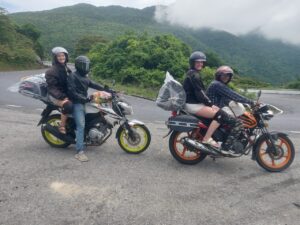

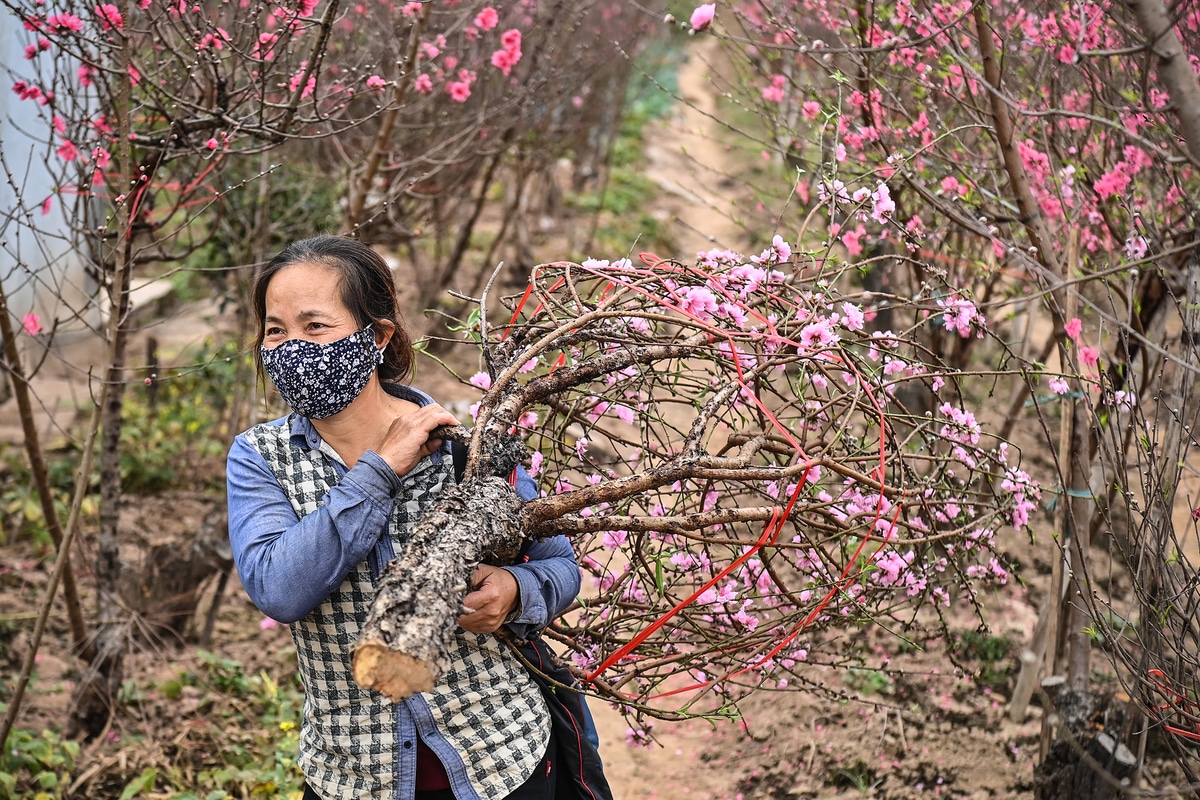
Riding through Vietnam in January or February means witnessing a transformation. Streets turn into rivers of color as motorbikes haul Kumquat, Peach, and Apricot trees. These aren’t just decorations like Christmas trees; they are living symbols of luck and vitality.
While we explore the folklore below, ensure you know how to navigate these busy streets by checking The Ultimate Guide to Riding Vietnam During Tet.
Just as the climate shifts from the misty, jagged mountains of the north to the flat, tropical delta of the south, so do the preferences for Tet flowers. This botanical divide is one of the most distinct cultural markers between the two regions.
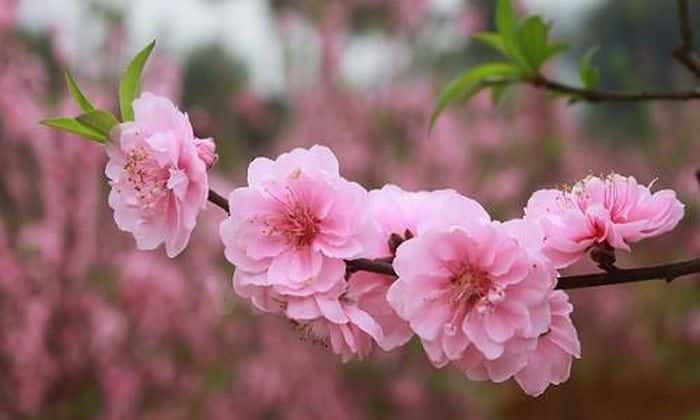
In Hanoi and the northern provinces, the Peach Blossom (Prunus persica) is the undisputed king of Tet. Thriving in the cooler, often misty winter air, its delicate pink petals are seen as a symbol of resilience and brave beauty. The tree has deep spiritual roots in northern folklore; it is believed that the reddish-pink hue of the flowers frightens away evil spirits, acting as a spiritual shield for the home during the transition into the new year.
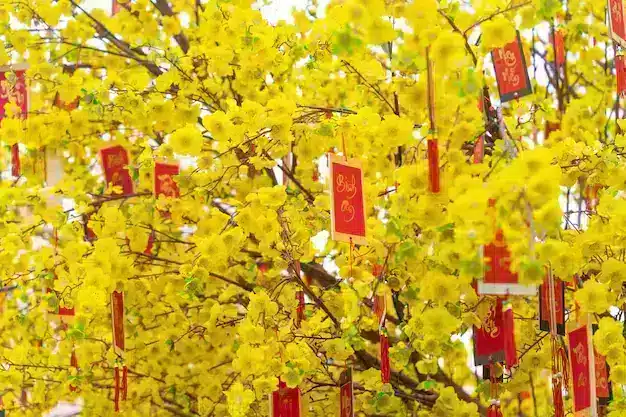
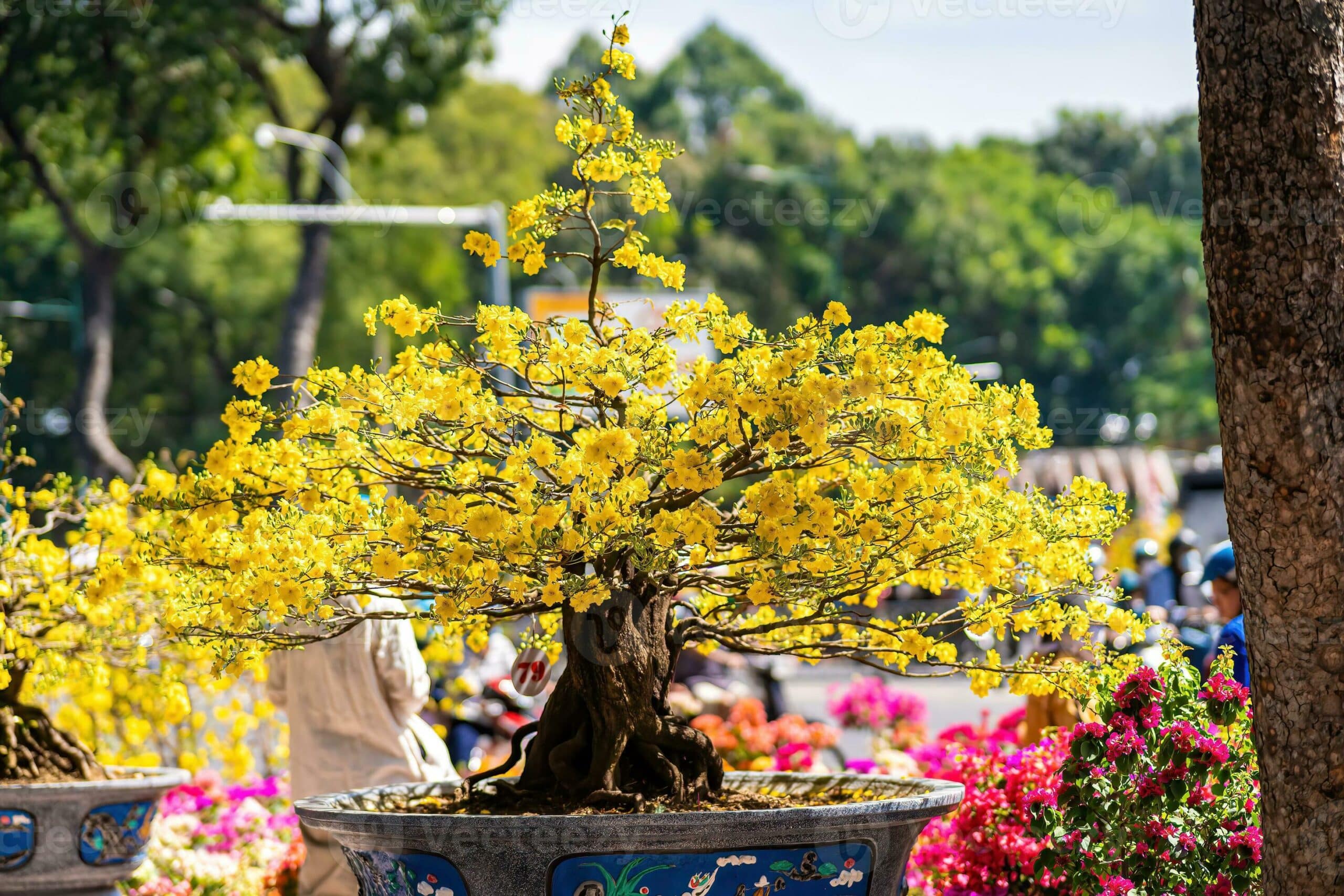
Travel south of the Hai Van Pass, and the color palette shifts from soft pinks to vibrant yellows. In Ho Chi Minh City and the Mekong Delta, the Yellow Apricot (Ochna integerrima) takes center stage. This preference is partly due to the warmer climate, which allows these sun-loving trees to flourish, but also due to color symbolism. In the south, yellow is the color of royalty and gold, directly linking the flower to wishes for financial prosperity and noble status.
The split isn’t just aesthetic or cultural; it is fundamentally agricultural. These trees are chosen based on what naturally blooms during the distinct winters of the two regions. Northern farmers have mastered the art of timing the Peach Blossom to open exactly during the cold snap of Tet, while Southern farmers manipulate the water cycles to force the Yellow Apricot to burst forth in the heat.
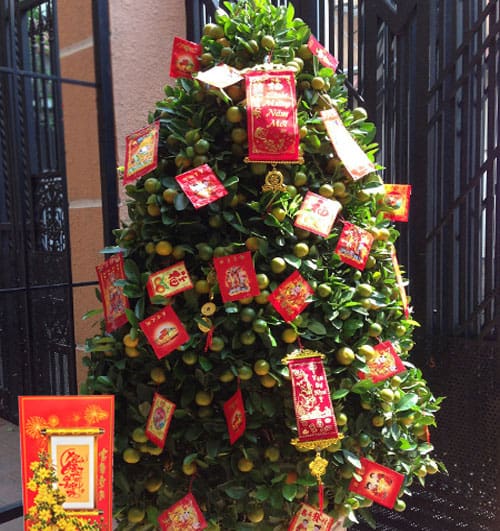
While the flowers highlight the differences between North and South, the Kumquat tree unites the country. You will find these fruit-laden trees in homes from the Chinese border in Sapa down to the floating markets of Ca Mau. The Kumquat is valued for its lush green leaves and bright orange fruit, representing a “bountiful harvest” and a healthy, growing family. It is the safe, universal choice for any Vietnamese household.
Interestingly, in modern times, improved logistics means you will now see Peach Blossoms in Saigon and Yellow Apricots in Hanoi. Wealthy families often pay a premium to have trees shipped from the opposite end of the country to show sophistication and worldly appreciation, though keeping a northern tree alive in the southern heat (and vice versa) remains a gardening challenge.
In Vietnam, a tree is never just a tree. It is a vehicle for fortune, a guardian of the home, and a predictor of the future. The selection process is taken incredibly seriously because the “performance” of the tree is tied to the family’s luck.
When Southerners choose a branch of Yellow Apricot (Hoa Mai), they are counting the petals. The ideal flower has five petals, which are said to represent the five great blessings: happiness, longevity, wealth, luck, and beauty. A branch that has many five-petaled flowers is considered a magnet for good energy, whereas flowers with fewer petals are seen as less potent.
The Kumquat tree is a masterclass in family symbolism. The lush, dark green leaves represent the parents and grandparents—strong, protective, and vital. The abundant orange fruits represent the children and grandchildren. A tree that is packed with fruit symbolizes a wish for a large, healthy family and generational continuity. If a tree drops its fruit before Tet arrives, it is considered a bad omen for the family’s unity.
People use these trees as a form of organic fortune-telling. If a Peach Blossom or Apricot tree bursts into full bloom on the very first morning of Tet (Lunar New Year’s Day), the family rejoices, believing they are guaranteed a year of happiness and prosperity. This is why you will see people staring intensely at buds in the flower market—they are trying to calculate the exact timing of the bloom.
Conversely, if a tree fails to bloom, or “goes blind” (buds fall off without opening), it is considered an omen of a difficult year ahead, potentially signaling financial loss or health issues. This superstition puts immense pressure on the farmers to ensure their trees are robust enough to survive the journey from the field to the living room without going into shock.
Travelers often ask if they can buy plastic versions. While plastic trees exist, you will rarely find them in a traditional Vietnamese home during Tet. The cultural belief is that the tree must be alive to possess “Khi” (life force/chi). It is this living energy that revitalizes the home and combats the stagnant energy of the previous year. A dead or plastic object cannot generate this luck.
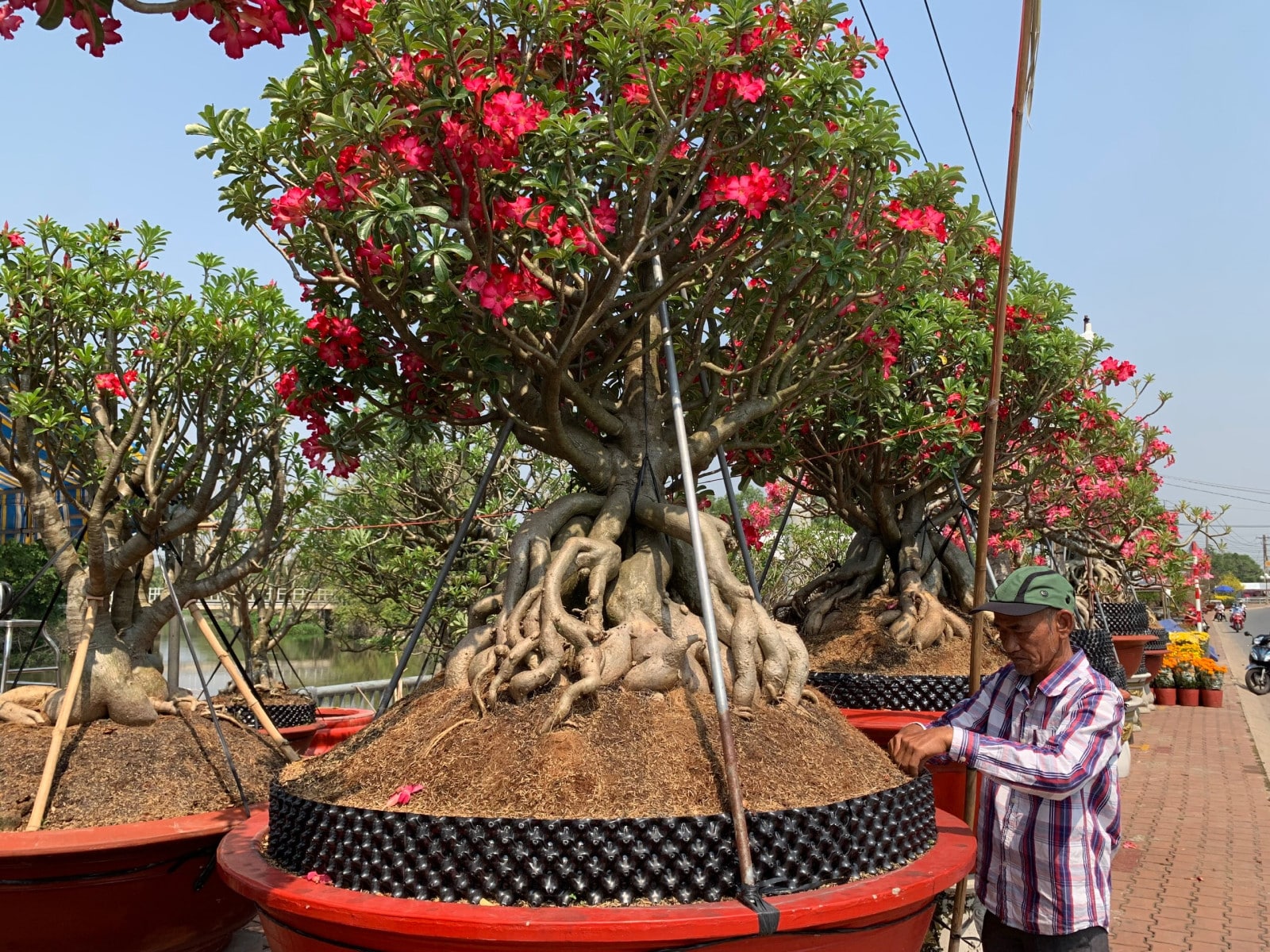
The economy of Tet flowers is massive, with huge sums of money exchanging hands. For many farmers, the sale of these trees constitutes their entire income for the year, making the weeks leading up to Tet a high-stakes period.
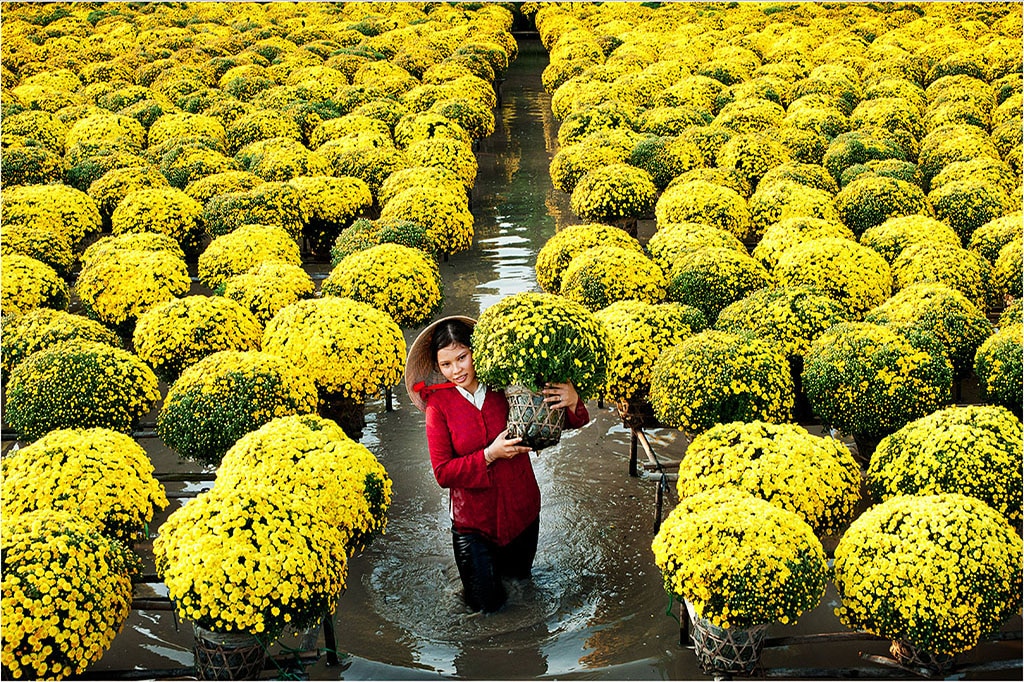
Did you know that many of the massive, ceiling-scraping trees you see in corporate lobbies or mansions are actually rented? A “Rent-A-Tree” industry thrives in Vietnam. These high-value ancient trees, often decades old with thick, mossy trunks, are cared for year-round by farmers and “leased” out for the 2-week holiday period. This allows businesses to have a spectacular display without the hassle of year-round maintenance.
This rental model is surprisingly sustainable. Instead of chopping down a tree and discarding it after two weeks (like the Western Christmas tree tradition), the Tet trees are returned to the farm. The farmers prune them, fertilize them, and rehabilitate them for the next 11 months. Some of these trees have been rented out for 10 or 20 years consecutively, growing larger and more expensive each cycle.
Prices for these trees can be astronomical, ranging from $20 USD for a small branch to $5,000+ USD for an ancient, artistically pruned bonsai. However, buyers view this not as an expense, but as an investment. The logic is simple: spending millions of dong is a rational decision if that specific tree brings billions of dong in luck and business success during the coming year.
In the weeks before Tet, designated streets in every city turn into 24/7 flower markets. Famous spots like Quang Ba in Hanoi or the Ben Binh Dong pier in Ho Chi Minh City become chaotic, colorful spectacles. These markets are best visited between 2 AM and 5 AM, when the wholesale trucks arrive and the atmosphere is electric. It is a photographer’s dream, but be prepared for noise, mud, and jostling crowds.
There are 4 main types of lily and they can be chosen to signify different things:
However, most people will make their choice based on how the colour will compliment the decoration of their household and the beauty of the flower rather than the symbolic meaning.
There is a fascinating game of “chicken” played at the markets. Prices are highest two weeks before Tet. As New Year’s Eve approaches, prices drop as sellers try to offload stock. However, wait too long, and you are left with the “ugly” trees that nobody wanted.
The savvy Vietnamese shopper knows exactly when to strike to get a beautiful tree at a discount, usually about 2 days before the holiday.
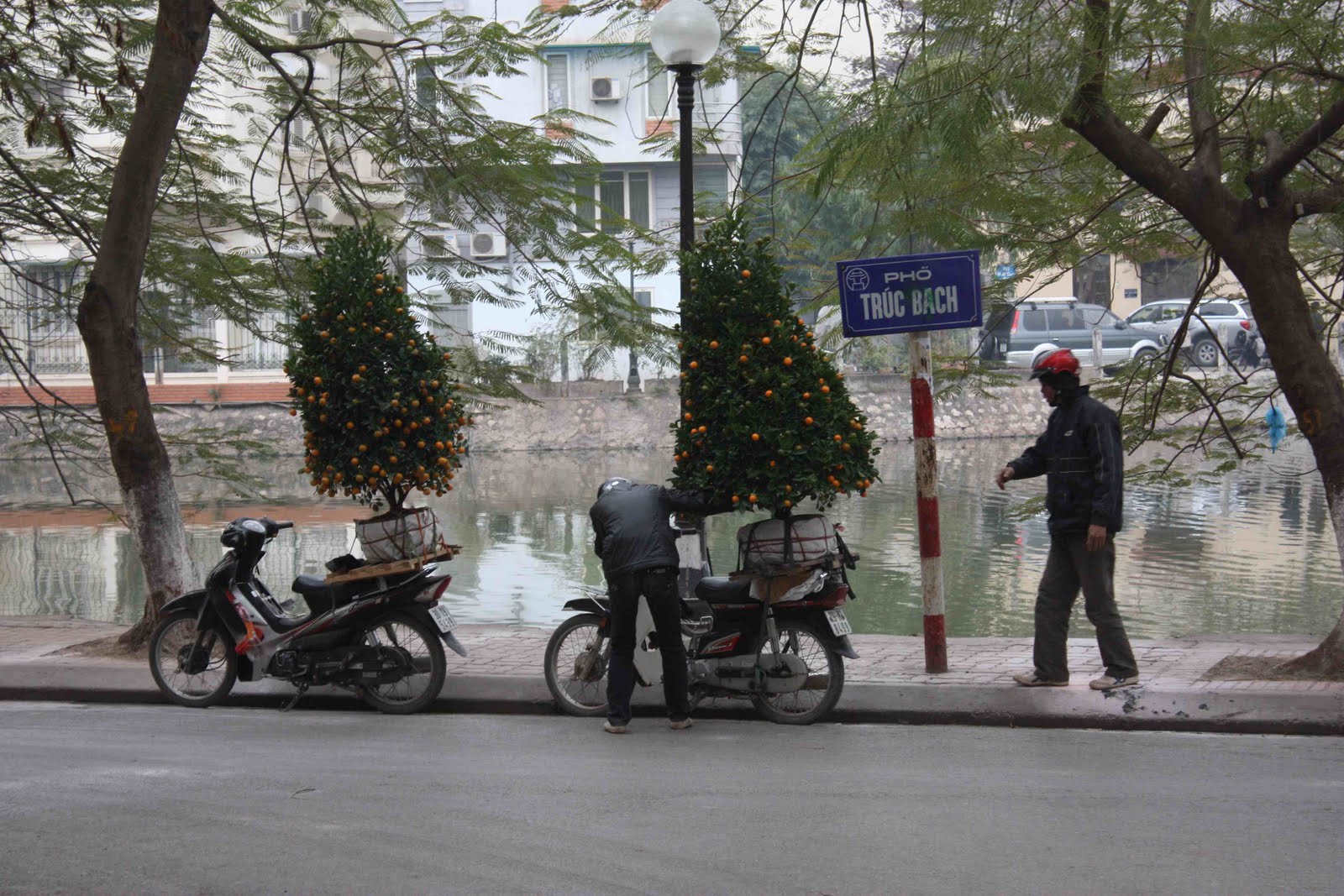
For the motorbike traveler, the most noticeable aspect of Tet is the logistical feat of moving these forests into the cities. It changes the dynamic of the road and requires a shift in riding style.
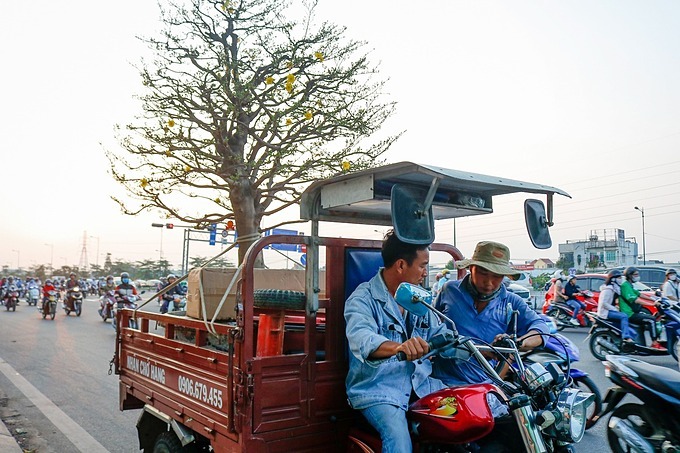
The motorbike is the primary transport for everything in Vietnam, including 6-foot trees. Seeing a massive Kumquat balanced on the back of a Honda Wave, or a Peach branch strapped to a pillion passenger, is a classic Vietnamese sight. These drivers are skilled, often balancing pots that weigh 50kg or more, but the physics of a motorbike are pushed to the limit.
These “travelling trees” create a unique hazard: camouflage. The foliage often obscures the rider’s vision and covers their brake lights and indicators. If you are riding behind a “tree transporter,” assume they cannot see you. Give them double the usual braking distance, as their bike is top-heavy and unstable. If they have to brake hard, the tree’s momentum can easily topple the bike.
Traffic patterns shift dramatically. The two weeks before Tet are the most congested of the year, with erratic driving as people rush to complete errands. However, from the afternoon of New Year’s Eve through the 3rd day of Tet, the cities empty out. Riding a motorbike through the silent, empty streets of Hanoi or Saigon on the first day of Tet is a surreal and wonderful experience—a photographer’s delight.
As the holiday draws closer, farmers will sell trees on literally every spare patch of pavement along the highways and national roads. This narrows the rideable road surface. Be hyper-aware of pedestrians stepping out from behind trees into the road, and motorbikes suddenly pulling over to inspect a potential purchase.
While there is a festive atmosphere, do not assume traffic laws are suspended. In fact, police often set up checkpoints in the weeks leading up to Tet to catch drunk drivers or those without licenses (Tet parties start early!). Ensure your international driving permit is valid and you are wearing a helmet at all times.
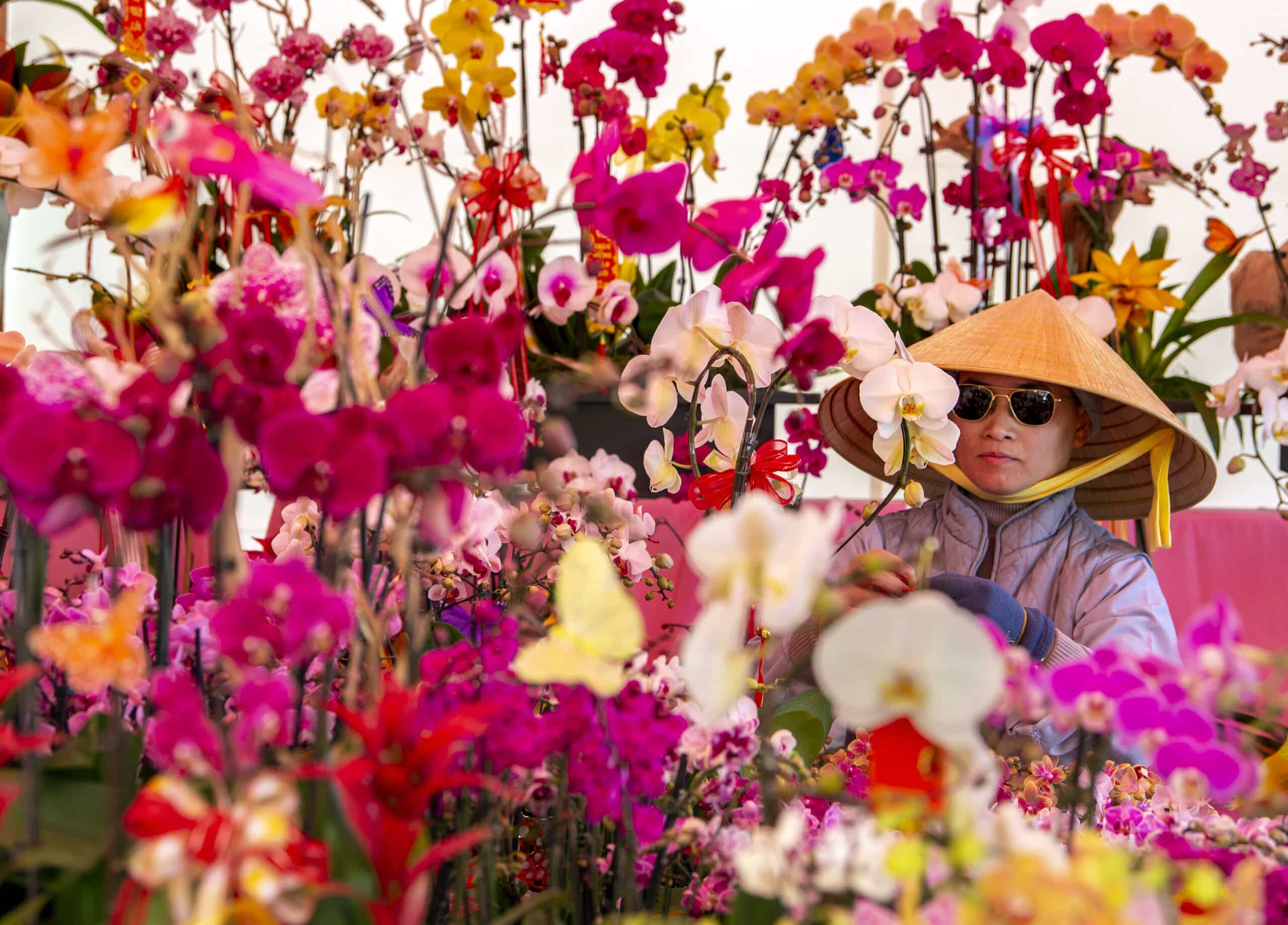
While the Peach, Apricot, and Kumquat dominate, other flowers play crucial supporting roles in the Tet decoration ecosystem. A truly traditional home will have a layered floral arrangement.
Often sold in large terracotta pots, Chrysanthemums (both yellow and russet-red) are placed at the entrance of the house or in the front yard. They symbolize a simple, pure life and “longevity.” Because they are hardy and last a long time, they represent stability and are used to “ground” the energy of the home.
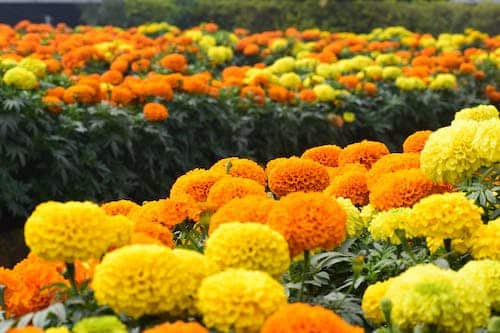
The Marigold is strictly associated with longevity and the afterlife. You will rarely see these used as decorative centerpieces; instead, they are placed on family altars to show filial piety to ancestors. Their pungent scent is also believed to repel insects, making them practical for placing near food offerings on the altar.
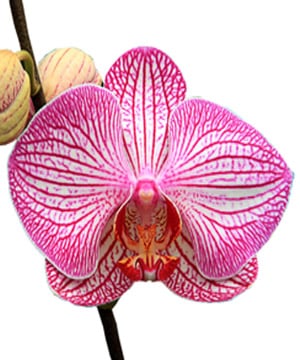
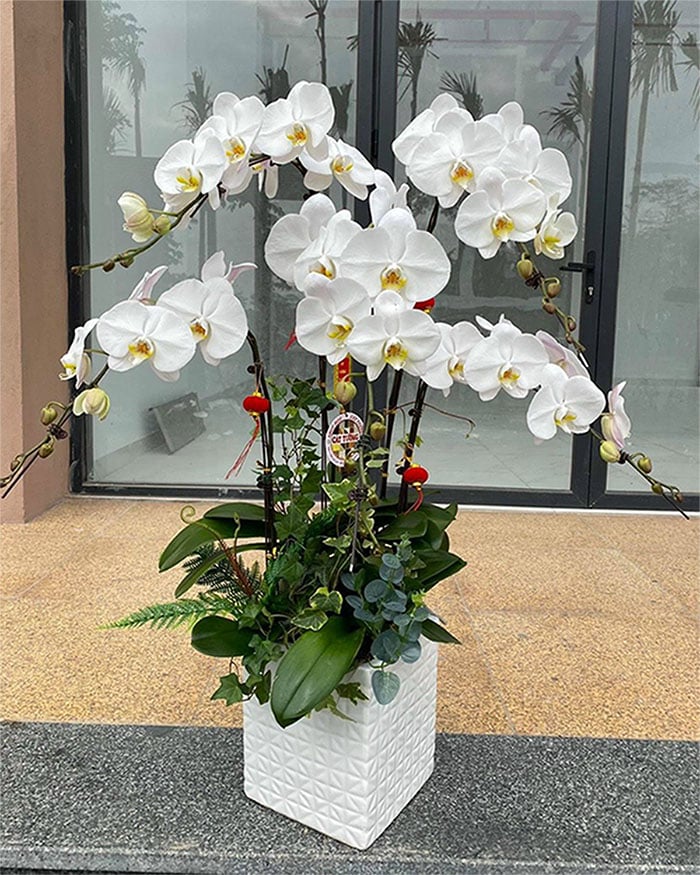
In recent years, the Orchid has risen in status to become the flower of the modern elite. Orchids represent nobility, luxury, and sophistication. They are frequently gifted between business partners or given to a boss. Unlike the rustic charm of a Peach branch, a complex Orchid arrangement signals high status and modern wealth.
The trees are rarely left bare. Once brought home, they are decorated with “lucky” accessories. You will see small red envelopes (Li Xi) hanging from the branches, often containing a small token amount of money. Gold and red ribbons, plastic coins, and greeting cards are also added. The goal is to make the tree look as “rich” and busy as possible to attract similar energy.
To ensure the luck doesn’t fade when the sun goes down, many families string flashing LED lights through the branches of their Tet trees. In the evenings, the streets of Vietnam glow with thousands of twinkling trees visible through open living room doors, creating a warm, communal atmosphere that is welcoming to travelers.
Traffic in major cities actually becomes much quieter during the actual Tet days (Days 1-4) as locals return to their hometowns. It is arguably the safest time to ride within the cities. However, the weeks leading up to Tet are chaotic with people transporting trees and gifts. We recommend extra caution during this pre-Tet rush, as road rules are often ignored in the haste to finish preparations.
Absolutely! Visiting a flower market (like Quang Ba in Hanoi or Ho Thi Ky in Saigon) is a cultural highlight. The markets are open to everyone. The best time to visit is early morning (4 AM) or late at night about 3-5 days before Tet. Be respectful of the vendors who are working on little sleep; ask before taking close-up portraits, but generally, the mood is festive and welcoming.
Many family-run businesses and restaurants close for 3-7 days to celebrate with their families. However, major tourist services often remain open or have shortened hours. At Rentabike Vietnam, we advise you to check our contact page for specific holiday hours and book your bike at least 2 weeks in advance, as supply can run low due to the holiday demand.
Geography is the main difference. The pink Peach Blossom (Hoa Dao) thrives in the cooler North and is associated with protection against spirits. The Yellow Apricot (Hoa Mai) prefers the warm South and represents wealth and royalty. You will see the colors shift as you ride from Hanoi to Ho Chi Minh City.
It is the most practical (and cheapest) way to transport them through the narrow alleyways of Vietnam! The Kumquat represents family unity and fertility, so bringing one home is a vital tradition. The sight of a giant tree “driving” a motorbike is one of the most unique photo opportunities you will get in Vietnam.
Tet is a time of joy, color, and open roads. The flowers you see lining the streets are more than just pretty foliage; they are the hopes and dreams of the Vietnamese people for the year to come. They represent a cultural resilience and an unshakeable optimism that good fortune is just around the corner.
Whether you are navigating the bustling flower markets of Hanoi to capture the perfect photo, or cruising the quiet coastal roads during the holiday tranquility, understanding these symbols adds a rich layer of depth to your journey. You aren’t just looking at trees; you are looking at the soul of the festival.
Ready to see the sea of flowers for yourself?
Book a Rental Bike today!
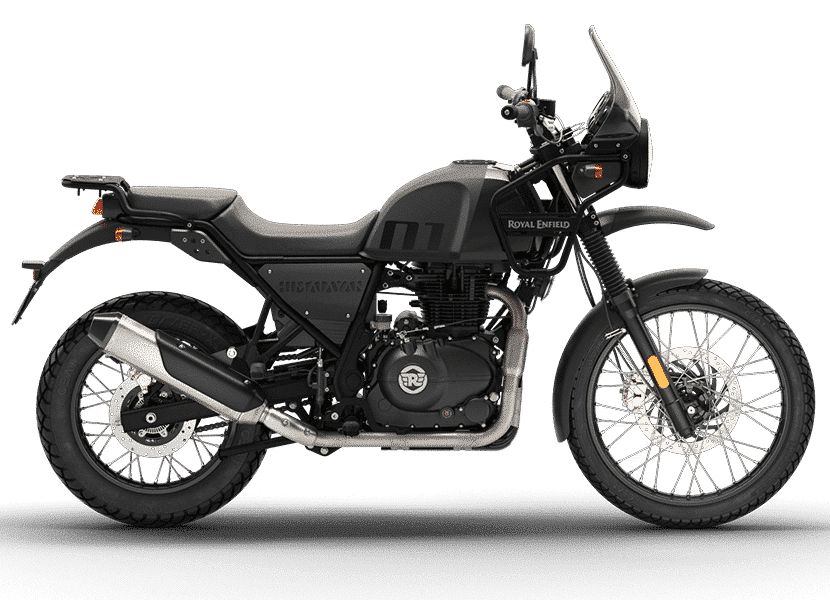
Engine Type
air-cooled, single cylinder, SOHC
Displacement
411 cc
Bore X Stroke
78 mm x 86 mm
Ignition
TCI
Fuel System
fuel injection
Compression Ratio
9.5:1
Starter
electric
Gearbox
5-speed
Front Suspension
telescopic forks; stanchion diameter 41 mm
Rear Suspension
linkage-type monoshock
Front Brakes
single disc brake, diameter 300 mm, 2-piston floating caliper
Rear Brakes
single disc brake, diameter 240 mm, single-piston floating caliper
Front Tyres
90/90 – 21
Rear Tyres
120/90 – 17
Wheelbase
1465 mm
Seat Height
800 mm
Ground Clearance
220 mm
Kerb Weight
199 kg
Fuel Capacity
15 litres
Dimensions
2190 mm (L) x 840 mm (W) x 1360 mm (H)
Daily
Total
Rider (CRF 300)
$220
Pillion
$120
Damage Waiver
$20
Private Room
$40
Support Vehicle*
$150
* All prices given are in USD and apply per rider except for the support vehicle. The support vehicle is free for groups of 7 or more, otherwise the cost is shared across the group.
Daily
Total
Rider (XR 150)
Rider (CRF 300)
Rider (CB 500X)
Rider (Himalayan 400)
$220
Rider (GS 1250)
Pillion
$120
Damage Waiver
$20
Private Room
$40
Support Vehicle*
$150
* All prices given are in USD and apply per rider except for the support vehicle. The support vehicle is free for groups of 7 or more, otherwise the cost is shared across the group.
Daily
Total
Jeep (1 PAX)
$210
Jeep (2 PAX)
$120
Jeep (3 PAX)
$90
Jeep (4+ PAX)
$80
Rider (Easy Rider)
$115
Rider (Self-Drive)
$105
Private Room
$15
* Our jeep tour prices operate on a sliding scale. The larger your group, the less each person pays—each member of your group will pay the lowest daily rate shown. For example, if you have a group of 4 or more, you will each only pay $80/day. All prices are given in USD.
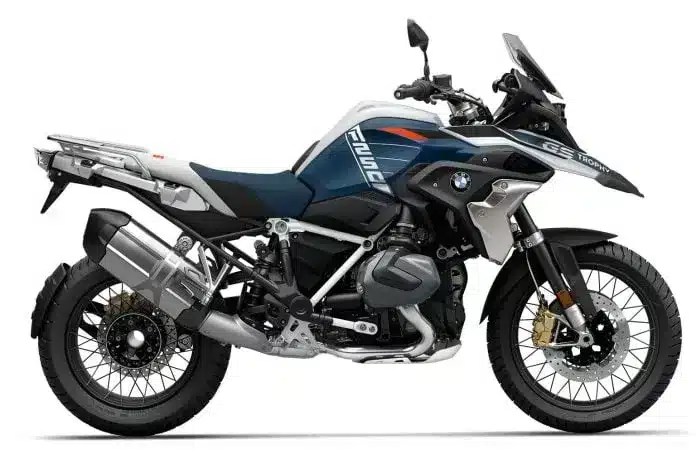
Engine Type
air-liquid cooled, twin cylinder, DOHC, boxer engine
Displacement
1255 cc
Bore X Stroke
102.5 mm x 76 mm
Ignition
FI
Fuel System
fuel injection
Compression Ratio
12.5:1
Starter
electric
Gearbox
6-speed
Front Suspension
BMW Motorrad Telelever; stanchion diameter 37 mm
Rear Suspension
single-sided swing arm with BMW Motorrad Paralever
Front Brakes
dual disc brake, floating brake discs, diameter 305 mm, 4-piston radial calipers
Rear Brakes
single disc brake, diameter 276 mm, double-piston floating caliper
Front Tyres
120/70 R19
Rear Tyres
170/60 R17
Wheelbase
1514 mm
Seat Height
850 mm
Ground Clearance
790 mm
Kerb Weight
249 kg
Fuel Capacity
20 litres
Dimensions
2207 mm (L) x 952.5mm (W) x 1430 mm (H)
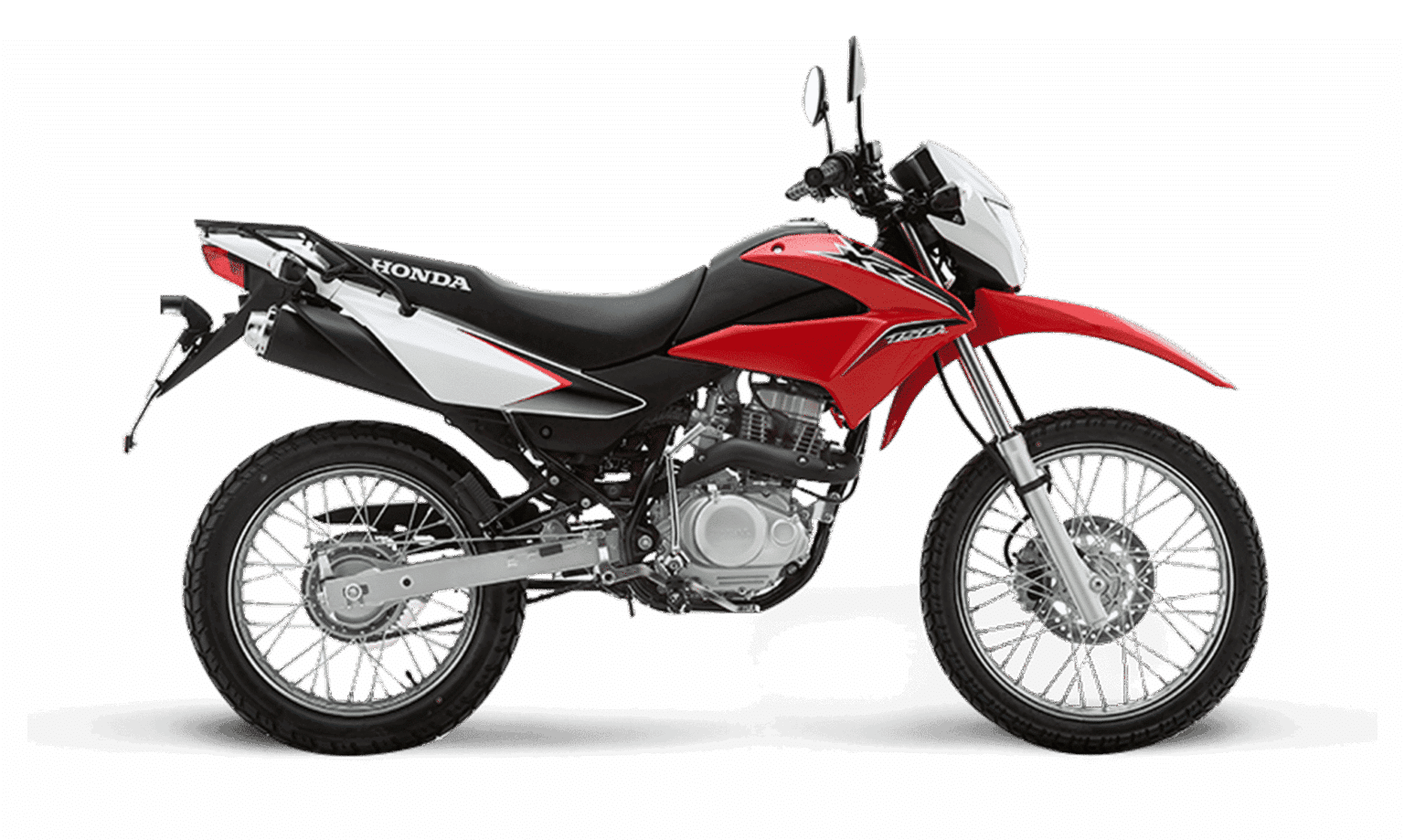
Engine Type
air cooled, OHC, single cylinder
Displacement
149 cc
Bore X Stroke
57.3 mm x 57.8 mm
Ignition
CDI
Fuel System
20 mm piston valve carburettor
Compression Ratio
9.5:1
Starter
electric with kick starter backup
Gearbox
5-speed
Front Suspension
telescopic fork, 180 mm axle travel
Rear Suspension
single shock swing arm, 150 mm axle travel
Front Brakes
dual piston caliper, 240 mm disc
Rear Brakes
mechanical drum
Front Tyres
90/90 19
Rear Tyres
110/90 17
Wheelbase
1362 mm
Seat Height
825 mm
Ground Clearance
243 mm
Kerb Weight
129 kg
Fuel Capacity
12 litres
Dimensions
2091 mm (L) x 811 mm (W) x 1125 mm (H)
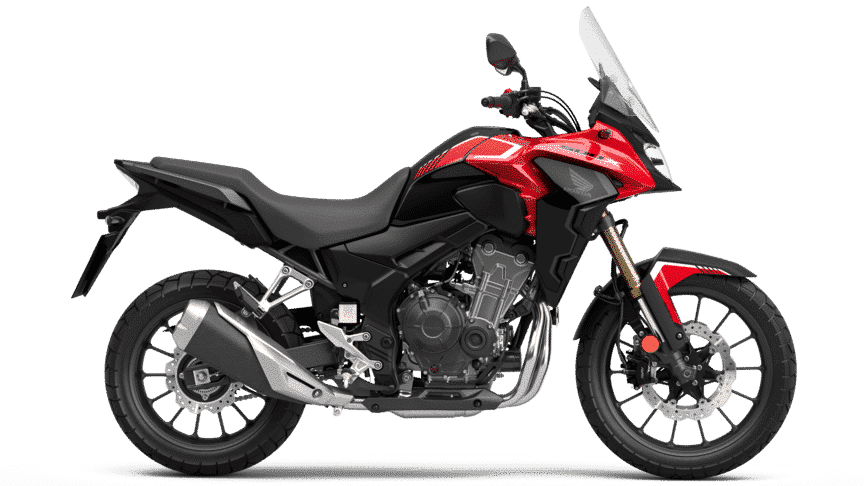
Engine Type
liquid cooled parallel-twin four stroke
Displacement
470 cc
Bore X Stroke
67 mm x 66.8 mm
Ignition
PGMI – FI
Fuel System
fuel injection
Compression Ratio
10.7:1
Starter
electric
Gearbox
6-speed
Front Suspension
41 mm SFF-BP USD Forks
Rear Suspension
Prolink Mono with 5 stage pre load adjuster
Front Brakes
dual 296 mm discs with 4 piston calipers; ABS
Rear Brakes
240 mm disc; ABS
Front Tyres
110/80R19M/C (59H)
Rear Tyres
160/60R17M/C
Wheelbase
1445 mm
Seat Height
830 mm
Ground Clearance
180 mm
Kerb Weight
199 kg
Fuel Capacity
17.7 litres
Dimensions
2,155 mm (L) x 830 mm (W) x 1,410 mm (H)
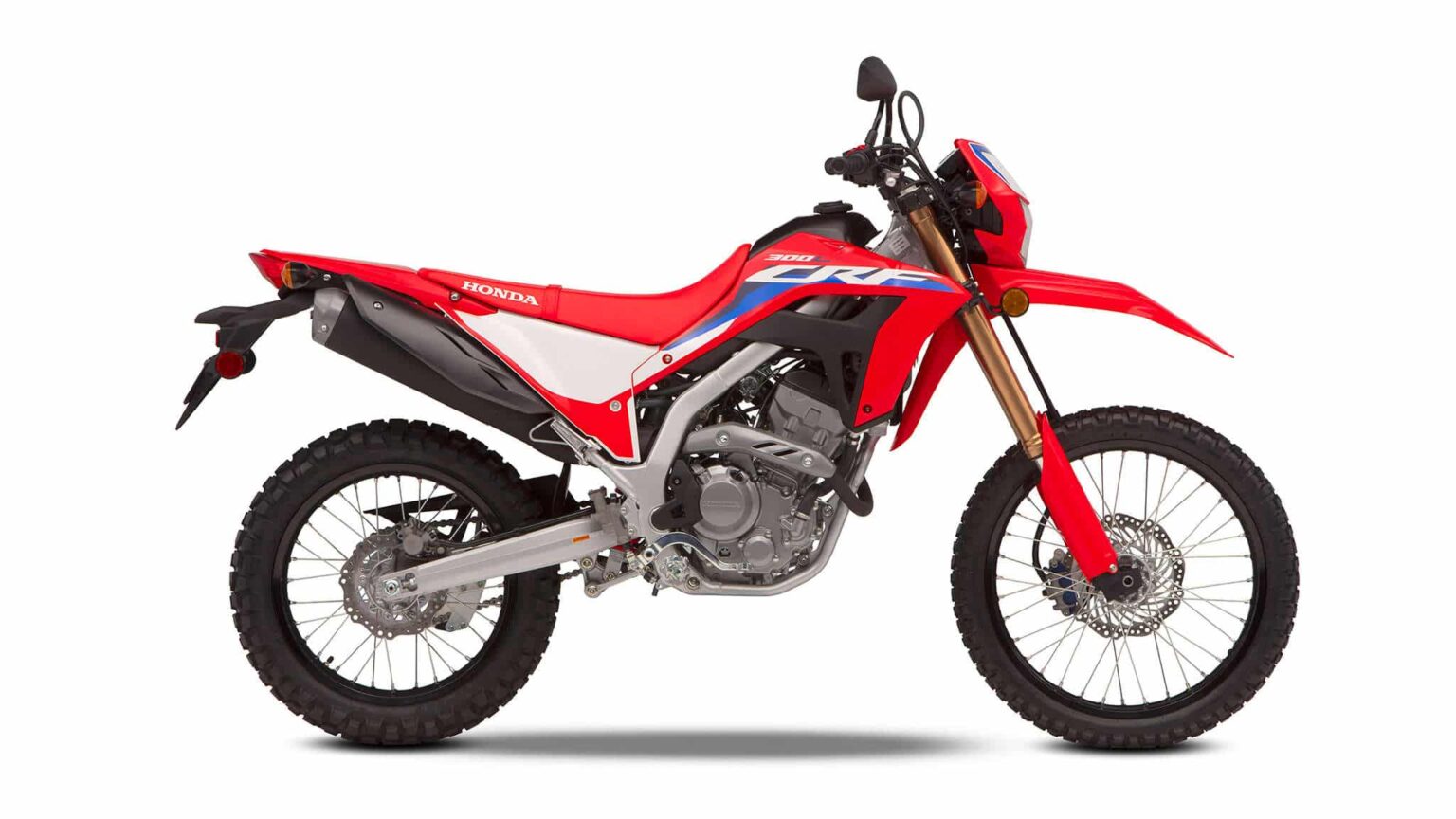
Engine Type
single cylinder, DOHC, liquid cooled
Displacement
286 cc
Bore X Stroke
76 mm x 63 mm
Ignition
Full Transistor Digital
Fuel System
PGM-FI electronic fuel injection
Compression Ratio
10.7:1
Starter
electric
Gearbox
5-speed
Front Suspension
43 mm telescopic upside down
Rear Suspension
Prolink Mono with 5 stage pre load adjuster
Front Brakes
Rear Brakes
220 mm disc, single piston caliper
Front Tyres
80/100 21
Rear Tyres
120/80 18
Wheelbase
1455 mm
Seat Height
880 mm
Ground Clearance
285 mm
Kerb Weight
142 kg
Fuel Capacity
7.8 litres
Dimensions
2230 mm (L) x 820 mm (W) x 1200 mm (H)